The Challenge: Paper-Based Inspection Couldn’t Keep Pace
With more than one million miles of underground pipelines across North America still in service, many past their intended lifespans, the organizations responsible for maintaining this infrastructure were relying on labor-intensive, paper-based inspection processes that couldn’t scale. Our client, a premier provider of pipeline protection and repair solutions and services for North America, wanted a better way to inspect, manage data for, and deliver timely and actionable information about pipeline assets. For this, our client engaged dymaptic and IT Nexus, another provider of software services.
Our Approach: Mapping the Gap Between Field and Decision-Maker
Having worked with data-intensive clients across many industries, the team at dymaptic understood that replacing a paper-based field process requires more than building an app. It requires a clear picture of how data moves from the field to a decision-maker’s desk, and every point of failure along the way. Working alongside IT Nexus, we began by assessing our client’s existing inspection workflow in detail, mapping the gaps between what field crews needed to capture and what the organization needed to act on. From there, we identified the right technology stack and defined the architecture for a fully integrated system covering field collection, cloud storage, data validation, and reporting. With the scope and approach agreed upon, we moved into development with the mobile application as our primary responsibility.
Our Solution: A Fully Integrated Digital Inspection Ecosystem
The goal was a single connected system that could handle everything from field data capture and hardware integration to cloud storage and real-time validation, built to work with or without a cellular signal. Our client’s existing field process consisted of visual inspection of assets, manual monitoring of cathodic protection systems, and recording the resulting data on paper. Together with our project partners, we set out to replace this rudimentary process with one integrated digital ecosystem for collecting and managing inspection and monitoring data. This system would fully handle data collection in the field, central storage in the cloud, statistical analysis, and data review. Our team identified Amazon Web Services and DynamoDB for the back-end infrastructure coupled with an Android mobile field application built natively in Java as the optimal technological palette with which to realize this system.
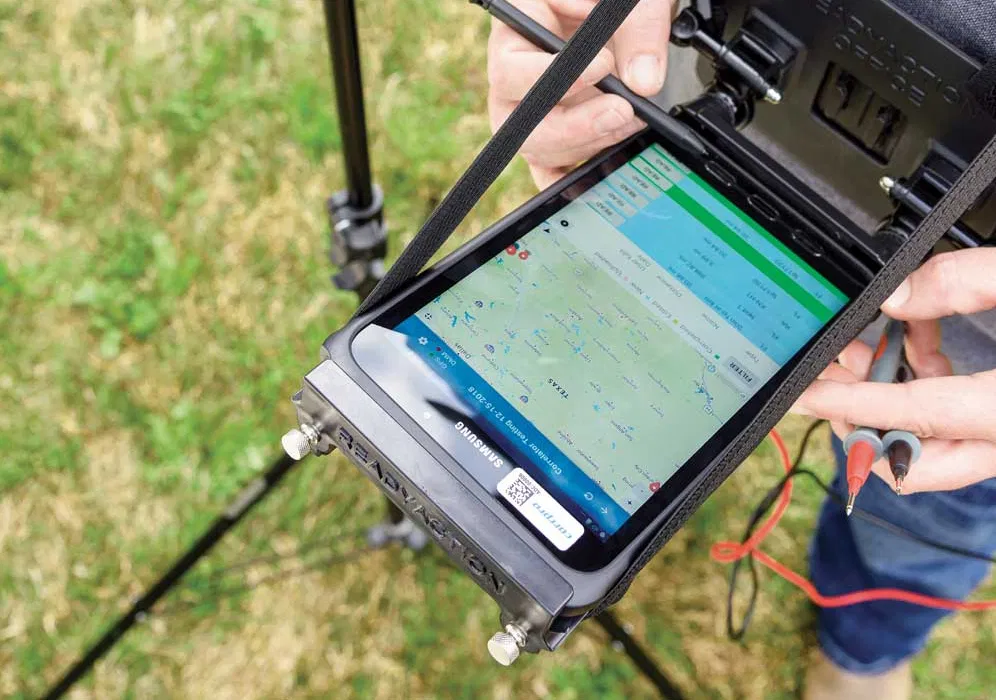
With our end goal defined, we moved forward with making it a reality. Given the dymaptic team’s expertise with the requisite mobile technologies, we led the development of the mobile application that would be used directly by inspection crews in the field. Drawing from our knowledge of field requirements and feedback gathered from our client, we built the application to function entirely independent of cellular connectivity, synchronizing data to the DynamoDB database as and when connectivity was available. Understanding the importance of ensuring data integrity when pushing to and pulling from remote data sources, we leveraged Amazon Web Services lambda expressions to perform data validation during this process. For data collection, we built the application to gather and record cathodic protection voltage readings, asset information, and high-accuracy locational data by connecting to voltmeters, RFID tag readers, and high-accuracy GPS devices via Bluetooth. In doing so, we both ensured the accuracy of this data at time of collection and greatly streamlined the data entry process for field staff. And finally, we collaborated with our client and leveraged our extensive user interface design experience to present this functionality to field workers in an intuitive and easy-to-use way.
The Result: Hundreds of Field Workers, One Connected System
The delivered system replaced a manual, paper-dependent process with a fast, accurate, and fully digital workflow that gave our client immediate access to actionable data across their entire pipeline network. In conjunction with our project partners at IT Nexus, the dymaptic team delivered a complete modernization of our client’s existing process for maintaining critical energy infrastructure, making the process of collecting and storing asset status information simple, fast, and accurate. Having this data immediately accessible in a digital format has enabled our client to proactively aggregate, analyze, and respond to that data in an intelligent and informed way. The Android mobile application, which we continue to enhance and support, is now used by hundreds of field workers in both the United States and Canada to ensure the smooth and safe operation of our client’s pipeline assets.